
Lost in the Crowd? How Crowding Affects Drug-Protein Binding
Macromolecular crowding, such as in the interior of biological cells, profoundly influences how molecules interact; however, its effects on drug-target binding rates and pathways remain poorly understood.
In a recent publication, researchers from the Molecular and Cellular Modelling (MCM) group have developed a novel multiresolution Brownian dynamics framework to tackle the complexity of crowded environments, combining atomistic and coarse-grained representations to simulate molecular association. “By simulating protein-small molecule complexes in environments with varying macromolecular crowder densities and types, we discovered that crowding exerts competing effects,” says Riccardo Beccaria, one of the first authors of the study.
The presence of other macromolecules can hinder binding by physically obstructing target sites and slowing down overall diffusion. However, the simulations revealed that crowding can also enhance association rates. “Through mechanisms involving molecular channeling and electrostatic caging — which effectively trap interacting molecules in close proximity — the crowded environment can guide molecules toward successful binding,” Beccaria adds.
Furthermore, the study demonstrates that crowding fundamentally alters not just the rate at which molecules associate, but also their binding pathways. “These results highlight the importance of considering the impact of crowded environments on biomolecular and therapeutic interactions,” says HITS group leader Rebecca Wade.
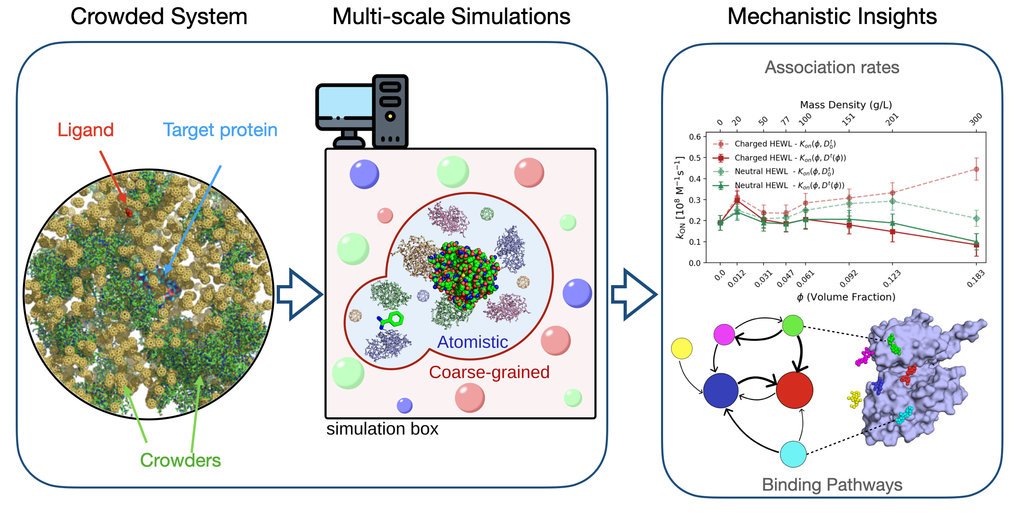
Graphical Abstract: From a Model of a Crowded System to Multiscale Simulations providing Mechanistic Insights
Publication:
Beccaria R, Muniz-Chicharro A, Wade RC.
Multiscale Brownian dynamics simulations reveal effects of macromolecular crowding on protein-ligand association (29 May 2026)
www.pnas.org/doi/10.1073/pnas.2617950123
Scientific Contact:
Prof. Dr. Rebecca Wade
Molecular and Cellular Modeling group
Heidelberg Institute for Theoretical Studies (HITS)
Phone: +49 6221 533 245
rebecca.wade@h-its.org
Riccardo Beccaria
Molecular and Cellular Modeling group
Heidelberg Institute for Theoretical Studies (HITS)
riccardo.beccaria@h-its.org
Media Contact:
Angela Michel
Head of Communications
Heidelberg Institute for Theoretical Studies (HITS)
angela.michel@h-its.org
About HITS
HITS, the Heidelberg Institute for Theoretical Studies, was established in 2010 by physicist and SAP co-founder Klaus Tschira (1940-2015) and the Klaus Tschira Foundation as a private, non-profit research institute. HITS conducts basic research in the natural, mathematical, and computer sciences. Major research directions include complex simulations across scales, making sense of data, and enabling science via computational research. Application areas range from molecular biology to astrophysics. An essential characteristic of the Institute is interdisciplinarity, implemented in numerous cross-group and cross-disciplinary projects. The base funding of HITS is provided by the Klaus Tschira Foundation.
 powered by Borlabs Cookie