
Discontinuity and disorder: explaining the luminosity bump in evolved stars
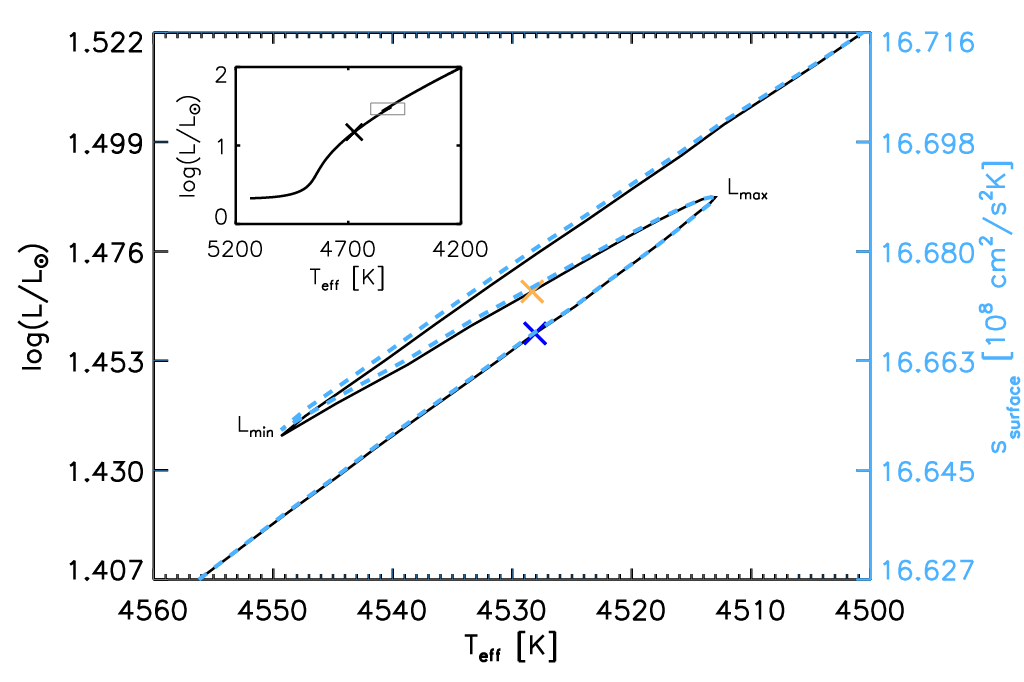
Towards the end of their lives, low-mass stars undergo an abrupt dip in their brightness, also known as the luminosity bump. Whereas the endpoint of this bump is well-understood, its onset has remained elusive. Now, in a paper published by The Astrophysical Journal Letters, Saskia Hekker, leader of the Theory and Observations of Stars group at the Heidelberg Institute for Theoretical Studies (HITS), finds that entropy is the key driver of the bump.
In observations and stellar evolution models alike, low-mass stars moving on the red-giant branch undergo a phenomenon known as the red-giant-branch bump, during which they temporarily experience a decrease in luminosity, where an increase would be expected. This confounding phenomenon has been investigated in Saskia Hekker’s latest research, wherein she demonstrates that the answer might be entropy, a measure of disorder. This process is usually precipitated by a discontinuity in the chemical composition of a star, emerging at the bottom of the convective stellar envelope, i.e. a star’s outer layers. In the course of evolution, the discontinuity moves to deeper layers with different temperatures and pressures, changing the entropy. This causes the star’s luminosity to decrease, thus defining the onset of the bump. “This succinct explanation of the onset of the bump, is the first quantitative description proposed so far,” says Hekker.
What does this mean for astrophysics?
Hekker’s research is the first of its kind and begins to answer a long-standing question in the history of astrophysics. According to Hekker, describing the mechanism behind the bump in this new way will provide key insights for the usage of the bump as an anchor point in stellar evolution theory.
Publication:
This research was presented in “The Astrophysical Journal Letters” under the title “The role of specific entropy in the onset of the luminosity bump” (https://doi.org/10.3847/2041-8213/ae9ff0).
Scientific Contact
Prof. dr. ir. Saskia Hekker
Group Leader Theory and Observations of Stars group
Heidelberg Institute for Theoretical Studies (HITS)
https://www.h-its.org/people/prof-dr-saskia-hekker/
Professor of Astrophysics
Heidelberg University
Media contact:
Angela Michel
Head of Communications
Heidelberg Institute for Theoretical Studies (HITS)
+49 (0)6221 533 329
angela.michel@h-its.org
About HITS
HITS, the Heidelberg Institute for Theoretical Studies, was established in 2010 by physicist and SAP co-founder Klaus Tschira (1940-2015) and the Klaus Tschira Foundation as a private, non-profit research institute. HITS conducts basic research in the natural, mathematical, and computer sciences. Major research directions include complex simulations across scales, making sense of data, and enabling science via computational research. Application areas range from molecular biology to astrophysics. An essential characteristic of the Institute is interdisciplinarity, implemented in numerous cross-group and cross-disciplinary projects. The base funding of HITS is provided by the Klaus Tschira Foundation.
 powered by Borlabs Cookie