
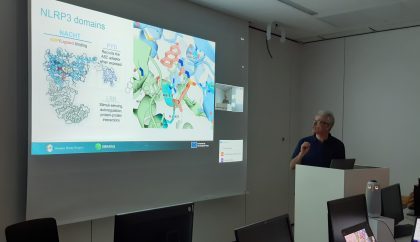
Tools for molecular design
On 21-23 June 2023, two workshops on Brain research took place at the Mathematikon, Heidelberg University: The second HBPMolSIM training workshop on …
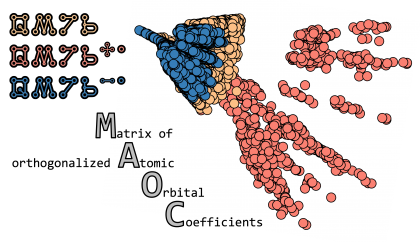
New representation for chemical machine learning
Stiv’s quantum-inspired representation for chemical machine learning entitled matrix of orthogonalised atomic orbital coefficients (MAOC) is published in the Special …

Richard Schwartz
Divide and Conquer: 5 Point Energy Minimization Thomson’s classic problem asks, for any N, which configurations of N points on …

Steve Trettel
Geometry from the Inside Geometry is one of the oldest ongoing projects of humanity, with an unbroken chain of deep thought …
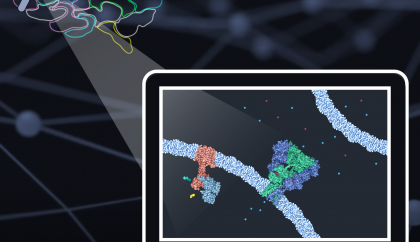
Registration open: 2nd HBPMolSim Training Workshop on Tools for Molecular Simulation of Neuronal Signaling Cascades and HBP BRAVE partner project open meeting
The second HBPMolSIM training workshop on Tools for Molecular Simulation of Neuronal Signaling Cascades will take place in hybrid format on 21…
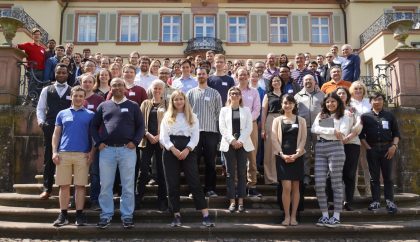
SIMPLAIX Workshop: Thanks to all participants!
A big thank you to all the speakers and participants for making last week’s SIMPLAIX Workshop on “Machine Learning for …

A step forward: Workshop for the “Habitable” board game
A team of young researchers at HITS has received 10,000 euros in the university competition for the Science Year “Our Universe” to …
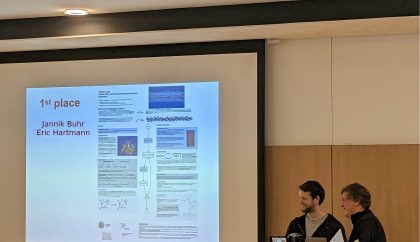
We congratulate: Poster award for Jannik and Eric!
We happily announce that two of our MBM colleagues have won the poster prize at the Computer Simulation and Theory of …
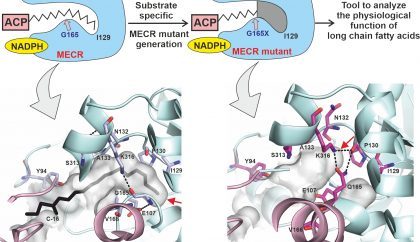
As they live and breathe – the role of long-chain fatty acids in cellular respiration
Cellular respiration is a complex and highly regulated process that allows cells to draw energy from nutrition. An international team of …
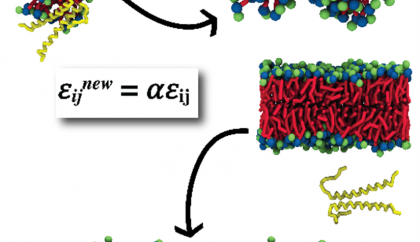
Simulation of transmembrane proteins in lipid environments: not always an easy task
Researchers in the Molecular and Cellular Modeling group (MCM) at HITS have recently released the first parameters of a micelle-forming lipid …
 powered by Borlabs Cookie