
It takes two to trigger – Astronomers make key breakthrough in what causes Type Ia Supernovae
An international team of astronomers have found compelling evidence that at least some Type Ia supernovae are produced by two white dwarf stars in a close binary system, using a centuries-old imprint in the explosion’s debris to reconstruct the system that existed just before it detonated.
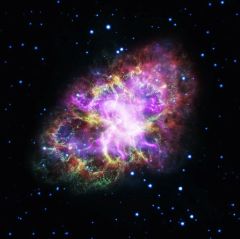
Type Ia supernovae are extremely valuable to astronomers because their predictable brightness allows astronomers to measure cosmic distances. Observations of these explosions helped establish that the Universe’s expansion is accelerating, thus contributing to the 2011 Nobel Prize in Physics for Brian Schmidt, Adam Riess and Saul Perlmutter.
Their origin, however, has been a long-standing mystery. A new study, led by Priyam Das, a PhD student at the University of New South Wales Canberra (Australia) and – together with co-authors Ivo Seitenzahl and Ashley Ruiter – a visiting scientist at the Heidelberg Institute for Theoretical Studies (HITS) in 2024, has now shed light on what type of stellar system triggers a Type Ia supernova, providing strong evidence for a two-white-dwarf origin orbiting closely together.
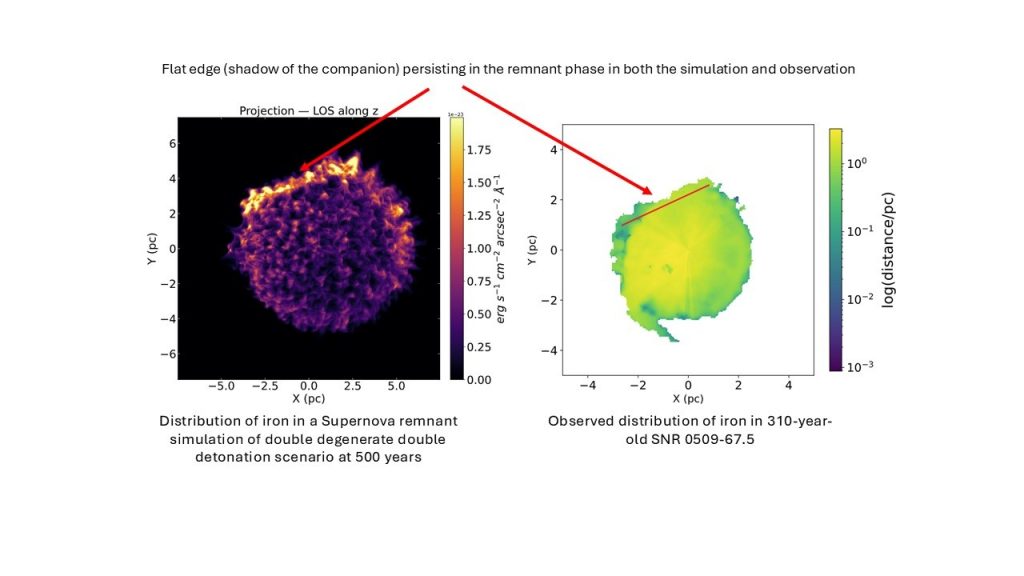
The international team of researchers studied the remains of a Type Ia supernova that exploded about 310 years ago in the Large Magellanic Cloud. By studying the expanding debris from that explosion the team was able to reconstruct the stars’ three-dimensional positions and movements. They discovered a “shadow of the companion”, a gap in the debris that appears to have been created when one white dwarf blocked part of the explosion.
The findings, which according to co-author Brian Schmidt are groundbreaking, were made possible by the MUSE instrument on the European Southern Observatory’s Very Large Telescope. They challenge the traditional model of a white dwarf stealing material from a normal star and provide important new evidence about how these powerful explosions are triggered.
“The discovery could significantly improve our understanding the physical mechanism of Type Ia supernovae ,” concludes Fritz Roepke, head of the Physics of Stellar Objects group at HITS and one of the co-authors of the study.
More information and images: Press release by the UNSW Canberra https://www.unsw.edu.au/news/2026/08/astronomers-solve-key-mystery-behind-one-of-the-universe-s-most-
Publication:
This research was presented in “Monthly Notices of the Royal Astronomical Society” under the title “Deep MUSE observations of SNR 0509–67.5 reveal a double-degenerate merger progenitor” (https://academic.oup.com/mnras/article/550/4/stag1329/8748215).
The project involved researchers from the University of New South Wales Canberra, the Australian National University, the University of Manitoba, RIKEN Centre for Interdisciplinary Theoretical and Mathematical Sciences, Max Planck Institute for Astrophysics, Heidelberg Institute for Theoretical Studies, and the Centre for Astronomy at Heidelberg University.
Scientific Contact:
Prof. Friedrich Roepke
Group Leader
Physics of Stellar Objects
Heidelberg Institute for Theoretical Studies (HITS)
https://www.h-its.org/people/prof-dr-friedrich-ropke/
Media contact:
Angela Michel
Head of Communications
Heidelberg Institute for Theoretical Studies (HITS)
+49 (0)6221 533 329
angela.michel@h-its.org
About HITS
HITS, the Heidelberg Institute for Theoretical Studies, was established in 2010 by physicist and SAP co-founder Klaus Tschira (1940-2015) and the Klaus Tschira Foundation as a private, non-profit research institute. HITS conducts basic research in the natural, mathematical, and computer sciences. Major research directions include complex simulations across scales, making sense of data, and enabling science via computational research. Application areas range from molecular biology to astrophysics. An essential characteristic of the Institute is interdisciplinarity, implemented in numerous cross-group and cross-disciplinary projects. The base funding of HITS is provided by the Klaus Tschira Foundation.
 powered by Borlabs Cookie