
ERC Synergy Grant for SIMPLAIX-PI Pascal Friederich
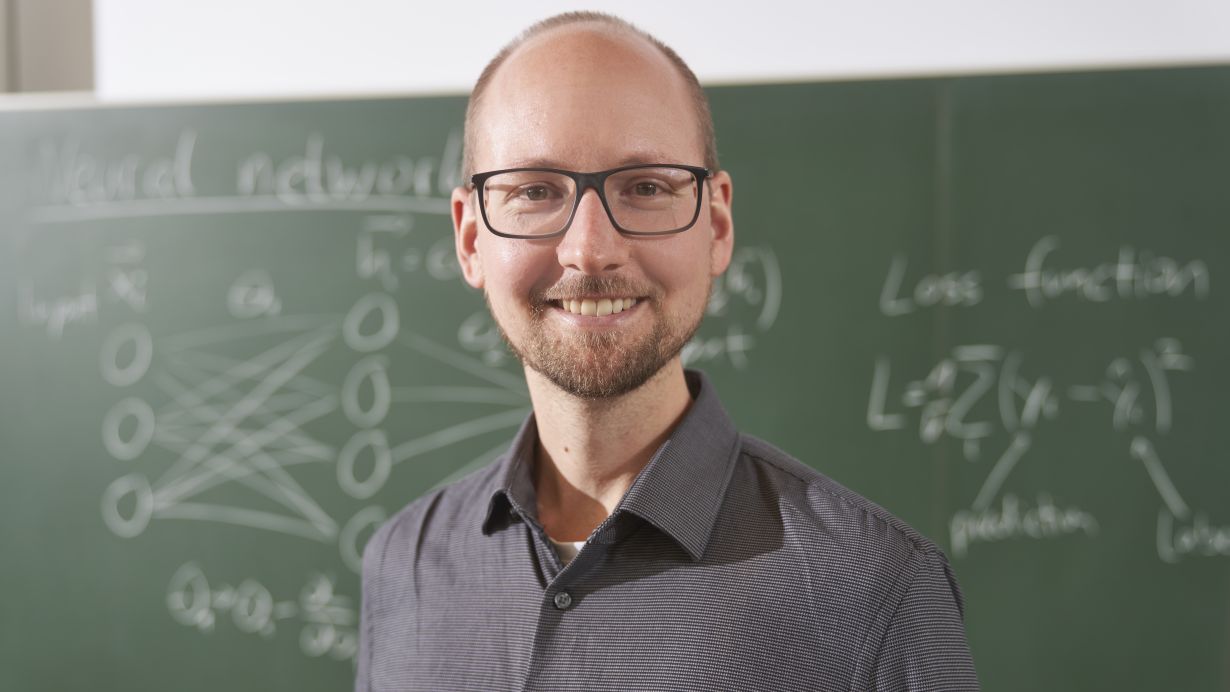
SIMPLAIX Principal Investigator Pascal Friederich from the Karlsruhe Institute of Technology (KIT) has been awarded an ERC Synergy Grant for the ODDITY (On-Demand DIscovery by Molecular IngenuiTY) project, in collaboration with partners at the Forschungszentrum Jülich and the University of Oxford.
This project combines artificial intelligence with a novel modular chemical system in order to significantly accelerate the finding of new materials tailored to specific applications, such as photovoltaics. The European Research Council (ERC) is funding the project with 9.7 million euro over six years.
Friederich and his partners are approaching the development of new materials differently, starting with the desired function and then working backwards to develop a molecule – a process known as reversible modular chemistry. This involves chemical bonds that can be assembled and rearranged rather than remaining permanently fixed, much like Lego blocks. The team is also designing AI models to identify suitable molecular structures and how they need to be assembled in order to obtain a molecule with specific properties without having to examine every possible combination individually.
Pascal Friederich is professor at the KIT Institute of Nanotechnology (INT) and co-affiliated with the Institute for Anthropomatics and Robotics (IAR). He heads the research group AiMat (Artificial Intelligence for Materials Sciences), and, since October 2021, has been one of the Principal Investigators in the SIMPLAIX collaboration, where he participates in seven out of eight projects.
More information on the KIT’s website: https://www.kit.edu/kit/pi_2026_093_ki-soll-neue-materialien-nach-mass-entwickeln.php
About HITS
HITS, the Heidelberg Institute for Theoretical Studies, was established in 2010 by physicist and SAP co-founder Klaus Tschira (1940-2015) and the Klaus Tschira Foundation as a private, non-profit research institute. HITS conducts basic research in the natural, mathematical, and computer sciences. Major research directions include complex simulations across scales, making sense of data, and enabling science via computational research. Application areas range from molecular biology to astrophysics. An essential characteristic of the Institute is interdisciplinarity, implemented in numerous cross-group and cross-disciplinary projects. The base funding of HITS is provided by the Klaus Tschira Foundation.
 powered by Borlabs Cookie