
4th SIMPLAIX Workshop on “Machine Learning for Multiscale Molecular Modeling”
For further information, see the workshop website: https://simplaix-workshop2026.h-its.org/


HITS organizes scientific events throughout the year. Each month, HITS hosts its colloquium series. If you like to receive an invitation, please use this registration form: https://www.h-its.org/registration/
Our research groups offer scientific workshops. Additionally, HITS offers talks and events for the general public in Heidelberg and surroundings.
For further information, see the workshop website: https://simplaix-workshop2026.h-its.org/

By Alexander Mäder, Hochschule der Medien, Stuttgart Flooding the zone with AI? The role of humans in science communication While AI-generated content is getting better and better, communication experts wonder what jobs will be left for them in the end. They can't be sure that there's a limit to what AI can do. […]

by Gábor Csányi Director Max Planck Institute for Polymer Research (MPI-P) I will report on our latest efforts to create universally applicable machine learning force fields using the MACE architecture. Large publicly available databases (such as OMAT and OMOL) and large scale GPU compute allow the construction of force field models that cover […]

The 18th SIMPLAIX internal project meeting will take at Mathematikon.

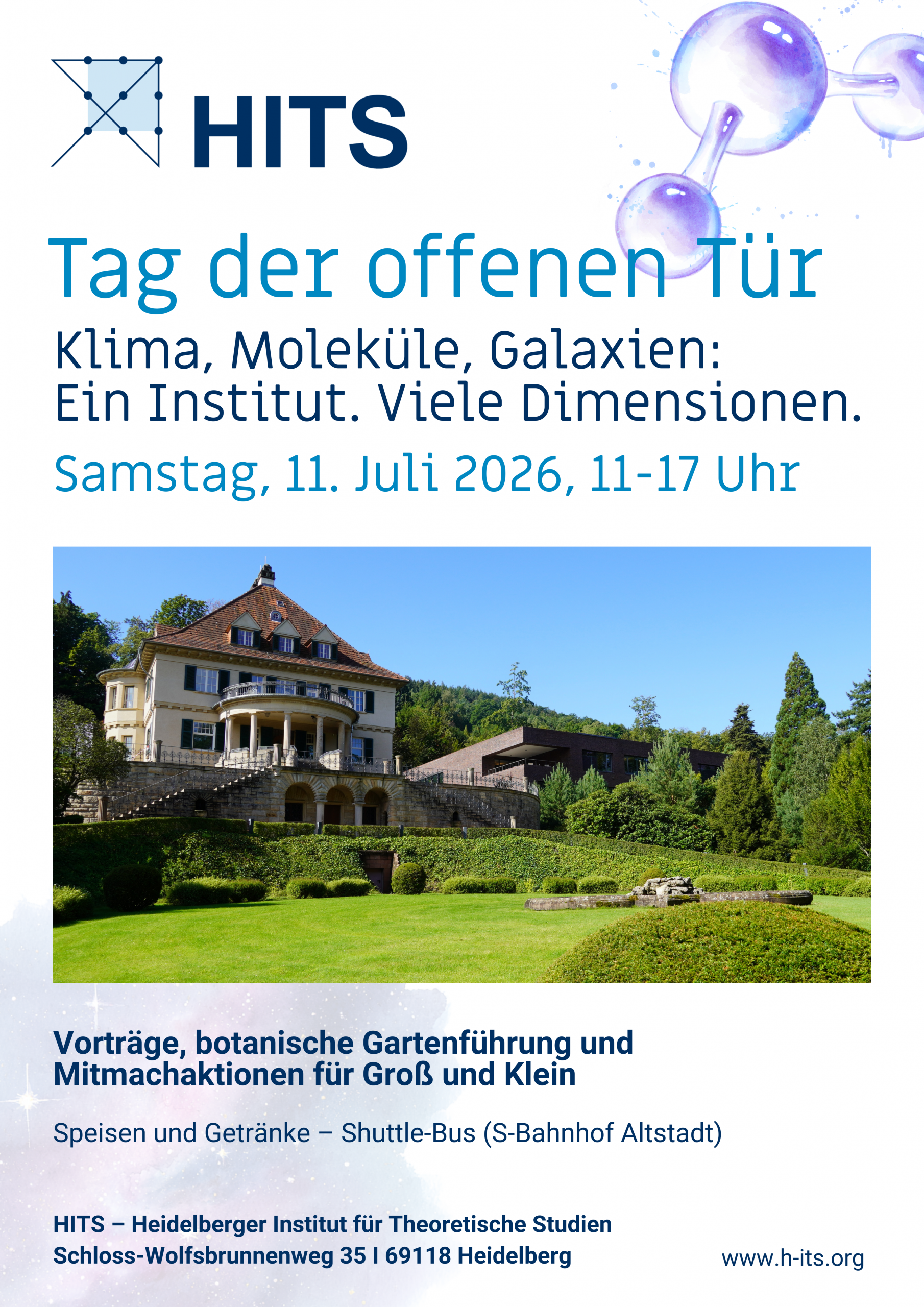
Come and join us for our Open Day at HITS on Saturday, 11 July, from 11am-5pm The Heidelberg Institute for Theoretical Studies will open its doors to the public again. The program includes science talks in English and German, presentations and hands-on stations, all showcasing the research of the Institute. One of the highlights this […]

by Sebastian Funk, London School of Hygiene & Tropical Medicine, London Predicting the course of an epidemic: models, data, and their limits Every new infectious disease outbreak raises the same urgent, quantitative questions: how large is it really, where is it heading, how many hospital beds will be needed. These are prediction problems, […]

by Yuji Sugita RIKEN Center for Computational Science RIKEN Pioneering Research Institute Department of Physics, The University of Tokyo For a CV, click here. It is well known that bimolecular droplets formed by liquid-liquid phase separation (LLPS) play a crucial role in understanding cellular biological processes and elucidating molecular mechanisms underlying several diseases. […]

by Simone Ponzetto, Mannheim University Abstract Recent years have seen a growing interest in the use of Natural Language Processing (NLP) methods for the analysis of political communication. While many computational approaches focus on topics, sentiment, or political stance, political discourse also conveys more subtle rhetorical, pragmatic, and moral dimensions that are central […]

by Michael Baake, Fakultät für Mathematik, Universität Bielefeld Markov matrices are a widely used tool for the empirical description of real-world data, which are usually sampled in discrete time steps. Since the underlying processes may (and often do) run in continuous time, one needs some time interpolation consistency, as the Finnish statistician Gustav […]
This page is only available in English
 powered by Borlabs Cookie