
Project 8: Machine-Learning Aided Multiscale Modeling of Cytochrome P450 Electron Transfer and Catalysis
Cytochrome P450 enzymes (CYPs) are membrane-bound monooxygenases that play central roles in drug metabolism and steroid biosynthesis. They are able to process a wide range of chemically diverse ligands. Catalysis requires the transfer of electrons from partner redox proteins and is modulated by homo- and hetero-oligomerization in the membrane. However, the molecular and structural determinants of electron transfer, ligand binding and protein–protein complex formation remain incompletely understood.
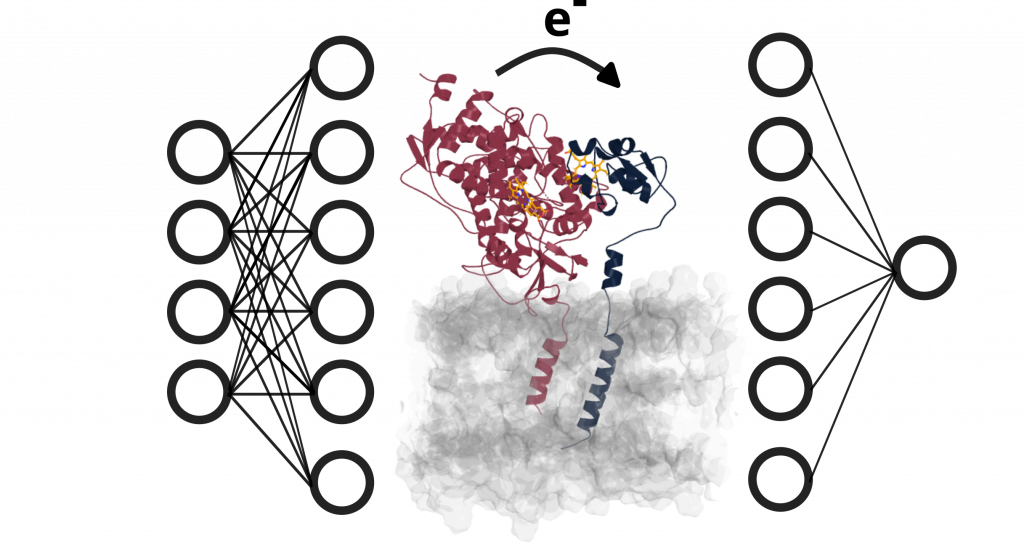
This project investigates the mechanisms influencing electron transfer and catalytic activity in CYP systems using a combined approach of multiscale molecular modeling and machine learning. Here, machine learning is applied in two complementary ways. First, machine-learned force fields trained on quantum-mechanical reference data will enable efficient molecular simulations.
These simulations will facilitate the study of conformational dynamics, ligand binding and protein complexation of CYP systems within membrane environments. Second, machine learning models will be developed to predict electron transfer rates, which are often the rate-limiting steps of CYP catalysis, directly from protein sequence and available experimental kinetic data.
Team

Prof. Dr. Rebecca Wade
Lead Principal Investigator and Deputy Scientific Director (HITS)
Phone: +49 6221 533 247
More Information
Prof. Frauke Gräter
Co-Principal Investigator (Max Planck Institute for Polymer Research, Mainz)
Phone: +49 (0)6131 379 180
More Information
Prof. Dr. Marcus Elstner
Co-Principal Investigator (Karlsruhe Institute of Technology)
Phone: +49 721 60845705
More Information
T.T.-Prof. Dr. Pascal Friederich
Co-Principal Investigator (Karlsruhe Institute of Technology)
Phone: +49 721 60844764
More Information
 powered by Borlabs Cookie