
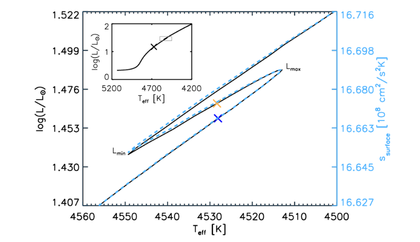
Discontinuity and disorder: explaining the luminosity bump in evolved stars
Towards the end of their lives, low-mass stars undergo an abrupt dip in their brightness, also known as the luminosity bump. …
Special issue: Mapping the Molecular Universe by Multiscale High-Throughput Screening and Machine Learning
Chemical space contains an enormous number of possible molecules, far too many to systematically enumerate. As this immense scale makes exhaustive …
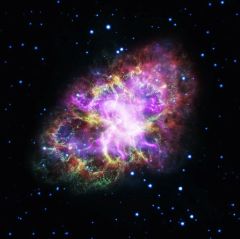
It takes two to trigger – Astronomers make key breakthrough in what causes Type Ia Supernovae
An international team of astronomers have found compelling evidence that at least some Type Ia supernovae are produced by two white …

ERC Advanced Grant for SIMPLAIX-PI Fred Hamprecht
SIMPLAIX-PI Fred Hamprecht from the Interdisciplinary Center for Scientific Computing of Heidelberg University (IWR) has received an ERC Advanced Grant for …
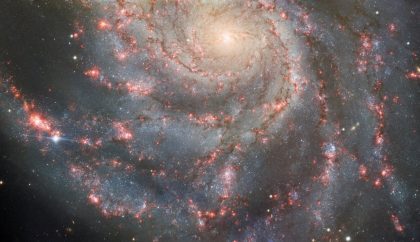
Not So Stable After All: Pulsations Reshape Massive Stars Before Explosion
Pulsations undergone by red supergiant stars right before they explode significantly influence their observable pre- and post-supernova properties. A study by …
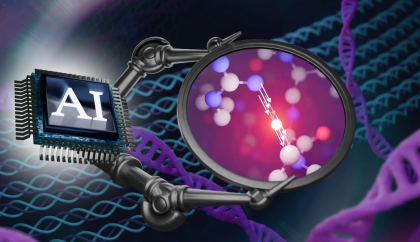
Molecular research: When speed meets precision
KIMMDY software visualizes biological processes in motion – conceived and originally developed at HITS, refined and published at the Max Planck Institute …

Registration now open: 4th SIMPLAIX Workshop on “Machine Learning for Multiscale Molecular Modeling”
The 4th SIMPLAIX Workshop on “Machine Learning for Multiscale Molecular Modeling” will take place in the Studio Villa Bosch in Heidelberg …
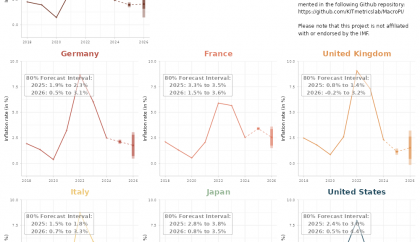
Forecasting made Simple and Transparent
From politicians and businesses to unions and individuals, many stakeholders are closely watching how economic conditions are likely to unfold in …
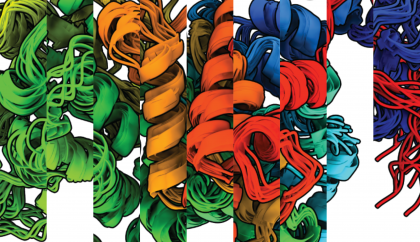
Predicting the Ever-Changing World of Protein Dynamics
In July 2025, a team of researchers from HITS and the Max Planck Institute for Polymer Research (MPIP) developed a model …
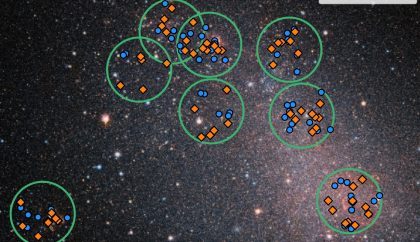
Massive stars also partner in metal-poor environments
Massive stars in metal-rich galaxies, such as in our own Milky Way, often have close partners. That this is also true …
 powered by Borlabs Cookie